
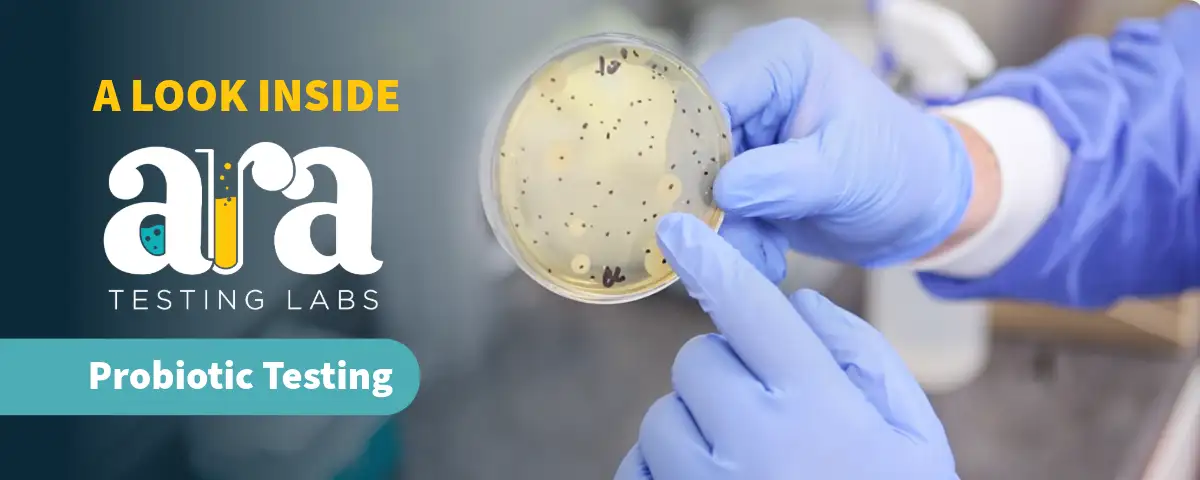
Probiotic enumeration isn’t a one‑size‑fits‑all test. Each strain grows best on specific agars, co-ingredients can introduce interference, and method selection takes research, especially with blends.
At Ara Testing Labs, our team uses compendial and industry methods, strain‑specific workflows, and hands‑on troubleshooting to ensure accurate, sound CFU results.
Why Probiotic Testing is So Complex
Probiotics are some of the most scientifically interesting and technically frustrating ingredients we test. Single‑strain raw materials tend to behave predictably, but once they’re formulated into multi‑strain blends or combined with botanicals, fibers, enzymes, or other co‑ingredients, everything changes.
Common challenges include:
- Antimicrobial botanicals that can suppress growth
- Matrix interference that prevents proper rehydration
- Blends with conflicting growth requirements
- Aerobic vs. anaerobic organisms in the same blend
- Shelf‑life instability when products aren’t stored correctly
Because of these challenges, probiotic enumeration method selection often becomes a research‑driven process. Customers may send a sample without knowing which method applies, and that’s where our team approach becomes essential. ISO 17025 does not allow us to choose the method for you, but we can provide informed suggestions. Once we review the strain list, the matrix, and the intended specification, we help guide you toward the most appropriate method for testing.
Strain‑Specific Methods:
No Two Probiotics Grow the Same
Each probiotic strain has its own preferred environment. That means different broths (MRS, peptone, saline), different agars (MRS agar, GYE agar, SABC agar), different rehydration steps, and different incubation conditions.
Examples include:
- Vegetative strains may require a 30‑minute rehydration in MRS broth at room temperature.
- Spore‑forming strains often need a heat shock at 75°C.
- Some strains skip rehydration entirely and go straight to dilution and plating
Even the initial dilution sometimes must be modified if the sample thickens or solidifies during rehydration. This is a common issue with powders containing gums, fibers, or botanicals.
Multi‑Strain Blends: When One Method Isn’t Enough
With multi‑strain blends, one method is usually not sufficient to capture the full colony forming unit (CFU) recovery. Aerobic strains often overlap or cross‑grow on the same media, and anaerobic strains can behave the same way. On top of that, some organisms grow more aggressively and overshadow slower‑growing strains. This is why multi‑strain products typically require more than one enumeration method to get accurate counts.
To do this, we often need to:
- Split the blend into aerobic vs. anaerobic methods
- Run multiple compendial methods in parallel
- Perform spike recovery studies to identify matrix inhibition
- Work with customers to clarify the correct specification
Storage Conditions Matter More Than People Realize
Probiotic viability is highly dependent on proper storage, and even small deviations can significantly impact shelf‑life. Many strains are not inherently stable and require refrigeration or low‑humidity environments to maintain their intended potency.
We routinely see heat‑sensitive organisms losing viability, moisture exposure reducing CFU counts, and strains designed for cold storage kept at ambient temperatures. To address these challenges, Ara Testing Labs provides stability studies following ICH guidelines, allowing customers to evaluate how their probiotic products perform over time.
By testing at defined intervals and under controlled environmental conditions, we help manufacturers validate shelf‑life claims, optimize formulations, and ensure long‑term product quality.
Behind the Scenes: What Happens in the Lab
Behind the scenes, probiotic enumeration looks very different from routine microbiology. Probiotic plates are typically full of colonies, so selecting the correct dilution is critical. Our analysts review multiple dilutions to identify the plate that falls within our standard counting range of 25–250 colonies. Depending on the method, you may see pour plates, Petrifilm methods, anaerobic chambers, and a mix of plates that are straightforward to read and others that require more careful interpretation.


Probiotic testing isn’t simple—and this episode proves why.
The Ara Testing Labs team breaks down the real challenges behind probiotic enumeration, from strain‑specific growth needs to tricky multi‑strain blends and ingredient interference. Get a behind‑the‑scenes look at plating, method selection, and storage factors that make or break CFU accuracy, all through the lens of hands‑on lab expertise and real‑world problem solving.
This is your chance to gain insight, ask questions, and learn alongside us!
Join us on this journey, and let’s explore the complexities of dietary supplement testing together. Send your questions to [email protected], we want to cover the topics that are important to you!
Share this Post
Latest Posts
Categories
Tags
- 2024 (1)
- 2025 (1)
- allergens (1)
- Ara and Friends (9)
- Booth (2)
- brands (1)
- compliance (2)
- departments (1)
- expiration date (1)
- FDA (5)
- GMP (1)
- GMP Compliance (1)
- labeling (1)
- learning (5)
- manufacturing (3)
- manufacturing date (1)
- news (1)
- oos (1)
- podcast (9)
- probiotics (4)
- qualification (1)
- qualifications (1)
- Quality (8)
- resource (14)
- samples (1)
- specs (1)
- SSW (2)
- stability study (1)
- supplements (1)
- supplier (1)
- testing (11)
Contact Us.
Curious about how we work? Let’s chat. We're happy to answer any question you have and explore new possibilities together.